Friday, October 26, 2012

What Water Is

          David Foster Wallace kicked off his commencement speech "This is Water" by saying
               "There are these two young fish swimming along, and they happen to meet with an older fish swimming the other way, who nods at them and says 'Morning, boys, how's the water?' And the two young fish swim on for a bit, and then one of them looks over at the other and goes 'What the hell is water?'"

      Wallace goes on to assure his listeners that the purpose of his speech is not for him to assume the role of an old fish that explains water's meaning to nearby youngsters. In fact, he makes this assertion at least three times to make sure he is not misunderstood. That's why it proves ironic that Wallace is indeed devoting his oration to defining 'water' that is the life we humans struggle though every day.

Water in this piece represents the flagrant but unnoticed aspects of life that we never see. The speaker reminds his audience that people generally choose to ignore anything that doesn't directly concern them, and that this is the "default-setting" for an average individual. Those who 'adjust' this setting are more aware and self-centered, and have the ability to embrace any aspect of life they encounter.

          Going back to the fish metaphor, it seems that the older fish is one of those rare, self-centered creatures that is at peace with the world around him. So...is the message of this story that only people old in age and experience are able to aquire this adjusting skill? Perhaps, but it is my opinion that children are more reflective of their surroundings, whereas adults typically come off as self-absorbed and distant. Therefore, it is possible we are all born with the talent to appreciate our surroundings, but we lose it as we age.

Friday, October 19, 2012

Paine's View on Pain

          This week we read several literature pieces of early American history. One of them is titled The Crisis by Thomas Paine. Paine was an outspoken colonist that wrote papers calling for an America free of British rule. He wrote The Crisis to urge fighting colonists to not lose faith. Paine makes the essay inspirational and dramatic by writing statements such as "I love the man that can smile in trouble, that can gather strength from distress, and grow brave by reflection."

Certainly, this quote evokes a sense of awe in people because, ultimately, we wish we will be able to make the best of difficult times. Apparently, Paine 'loves' those who are able to do so. Yet, is it wise to be so optimistic? Let's not forget that in those days, America was under Britain's thumb, the whole country was desperate, and people were losing family, friends, and faith to the war. Only a fool would disregard all of this and smile. But, according to Paine, that would be the respectable thing to do.

This principle of life can be reflected in today's society as well. Whenever something dreadful happens to us, we feel compelled to put on a bright face and try to forget the pain. But I think we have to accept the pain and mourn the incident because it is an essential part of our life. People have the right to despair and their grief  should not be hidden for the sake of false bravado. Earlier today, someone told me her dog had died recently. Then she gave a little laugh. I, on the other hand, don't find this particularily funny--it's horrible and should be treated as such.

          That's why, I choose to interpret the Thomas Paine quote a slightly different way: Be free to feel loss, but don't give up hope because eventually the situation will improve and you will walk away a more enlightened person.

Friday, October 12, 2012

John Proctor's Problems

          This week in English  there was debate regarding the legitimate antagonist in Arthur Miller's play The Crucible. The obvious answer would be Abigail Williams, but John Proctor is also a viable candidate.

          When I first read about the end of John Proctor's life, I felt somewhat vindicated. Even though he's the main tragic hero of the play, he initiated the whole sequence of miserable events by cheating on his wife. This made Abigail falsely interpret love for her and eventually, pull a prank which would result in others getting blamed for witchcraft. At that point, the situation spirals out of control with mob mentality dictating official court decisions and innocent people being killed for 'consorting with the Devil'.

          If I had somehow landed in his position, I would confess to being a witch. It might not be the moral solution to the problem, but at least I would emerge alive and be able to take care of my family. Proctor ignores the fact that his children have been left to some nearby farmers and that he is their only chance of living with a parent again. He just obsesses with self pity about his reputation, and deludes himself into thinking he's doing everyone some great favor by willingly heading off to the gallows. In reality, even if he becomes a saint in his last few hours of life, the village's structure has already collapsed and only a few people will remember him as a good, reputable citizen.

          This also ties into how an individual's identity is his most important possession. One of my favorite teachers claimed earlier today that society affects  external actions, while his inner feelings are comprised mainly of guilt and shame for being so easily swayed. Apparently, this doesn't apply to John Proctor, because although he debunks his concealed sins, society's hysteria never seems to touch him. He sees things for what they are very clearly from Act I to his untimely death, yet it takes him much too long to realize the errors of his ways and attempt to diffuse the situation. As people are being sentenced death left and right during this time, he can be perceived as the careless villian of this early American piece.

Friday, October 5, 2012

Hated Characters: Connections from The Crucible and Harry Potter

          This week in class we began Arthur Miller's The Crucible, which concerns the witch trials of Salem and the people involved. It becomes clear, throughout the first few acts, that Abigail Williams is responsible for the arrests of over thirty women in her village. She sets up Elizabeth, John Proctor's wife, to make it look as though the goodwife has evil powers so she can continue her affair with John once his wife is dead.
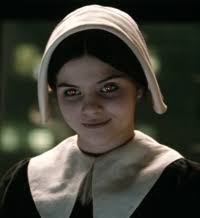

Due to her actions, Abigail is an insufferable character that can quickly be hated by audiences. Conversely, because it is fun to hate and criticize her, she can be interpreted as one of the best characters in the play. I think Abigail, my favorite character in The Crucible, can be linked to my least favorite character in the Harry Potter series: Ron Weasley.


Their most obvious similarity, perhaps, is their remarkable skill of 
ruining the relationships, and ultimately, lives, of the people nearest to them. This can be shown in their skewed sense of logic. Abigail assumes John Proctor will happily love and marry her if she kills his wife, while Ron is under the impression Hermione will continue to support him while he ridicules her and goes out with other girls.


          Also, when Mary Warren and Betty Parris rely on Abigail to protect them, she threatens and scares them right when they need her most. This causes Mary Warren to suffer some sort of breakdown later.  It relates to when Ron abandons his friends during their camping trip. While I enjoyed his absence, he does finally return, simply by showing up and being forgiven instantaneously. Harry tells him not to worry about it, and that "it's okay." It's okay?! This is not the first time Ron has done something like this; at least once in every book he turns his back on Harry or Hermione.
          Possibly Abigail's biggest accomplishment is her rapid rise to power. For the first eighteen years of her life, she is just a scheming servent; a preacher's irritating niece. Now, she is a manipulative young woman; ultimately the sole judge of which innocent women will be brought to court and probably hanged because her love obsessions. Likewise, Ron gains some power in the final book of the series. He becomes marginally more thoughtful, and smarter in the decisions he makes for the trio. In the first six books, he's just this idiot that tries to be funny, whereas now it appears he actually has significant contributions to share with the group. These similarities show how detested characters can become more interesting when fans indignantly point out their flaws and find entertainment in their personalities.